
Male vs Female Bearded Dragon: How to Tell the Difference
Male vs female bearded dragon differences are hard to see in babies, and that’s when most dragons go to new homes. So a dragon sold as a male sometimes turns out to be female, or the other way round. Once your dragon is a few months old, a quick look at the base of the tail usually settles it.
This guide shows you what to look for with drawn diagrams, how to lift the tail without hurting your dragon, and at what age each sign starts to work. A quick checker then weighs the signs together for you.
- The Tail-Base Check
- The Flashlight Trick
- Male or Female Checker
- At What Age Can You Tell?
- Femoral Pores
- Head, Beard, Size and Behavior
- Common Mistakes
- When to Ask a Vet
- Why It Matters: Housing and Eggs
- Can a Bearded Dragon Change Sex?
- FAQ
How to Sex a Bearded Dragon: The Tail-Base Check
The most reliable check you can do at home is at the base of the tail. Male bearded dragons have two reproductive organs called hemipenes (VCA Animal Hospitals). They sit inside the base of the tail, one on each side, and show as two bulges running from the vent toward the tail (The Unusual Pet Vets). Females don’t have them. A female shows one bump in the middle, or a flatter area (Exotic Direct).
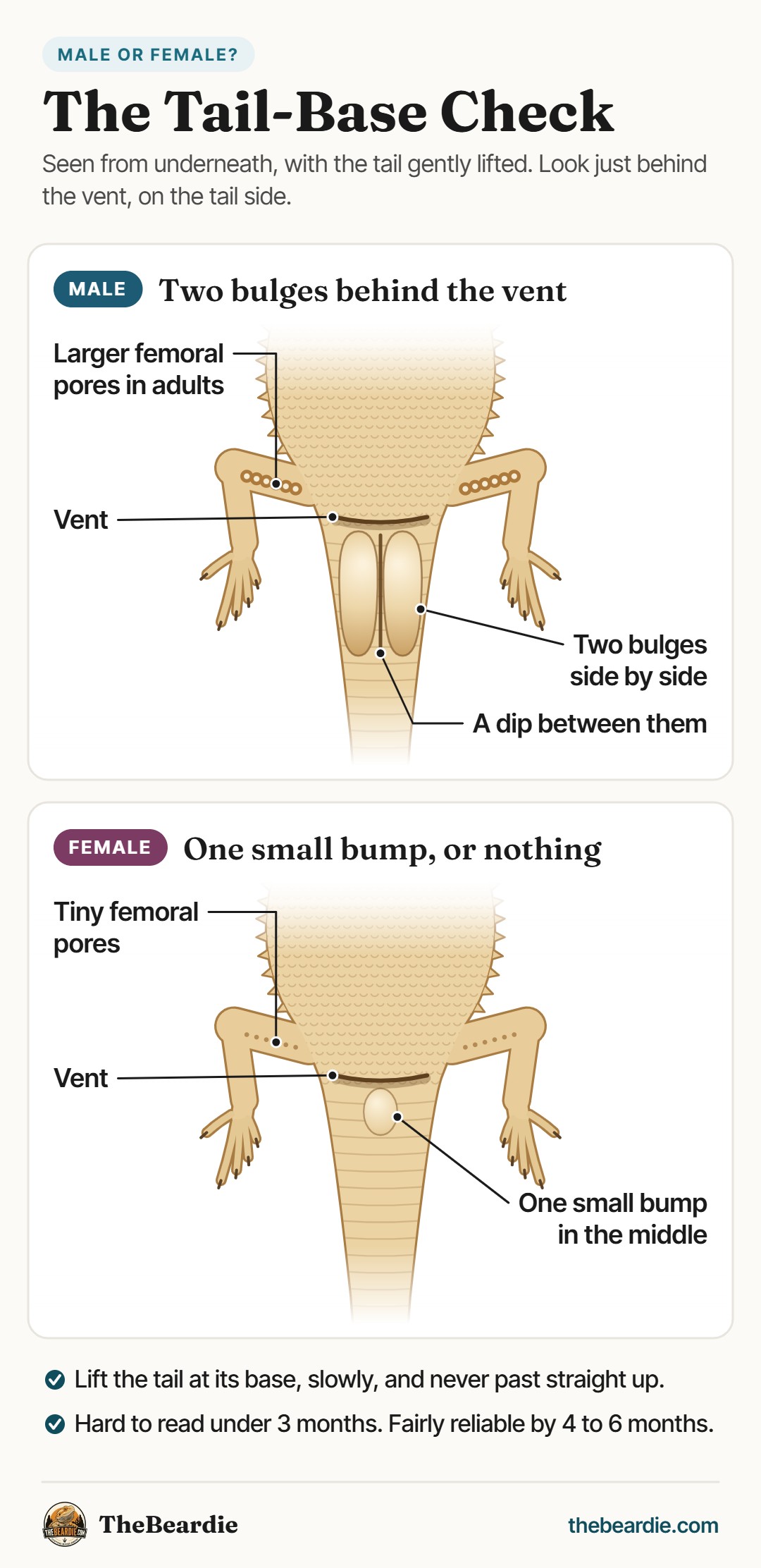
How to do it safely
- Pick a calm moment. Choose a time when your dragon is warm and relaxed. Keep the whole check under a minute.
- Support the whole body. Let your dragon rest on a flat surface or along your palm, with its belly and all four legs supported. Our guide to holding a bearded dragon shows how.
- Lift at the base, never the tip. Hold the tail near the body and raise it slowly. Straight up is as far as it should ever go, and you usually need less. Never bend it back over the body. A bearded dragon can’t drop its tail the way some lizards do, and a lost tail doesn’t grow back (Hepper).
- Look on the tail side of the vent. The bulges sit just behind the vent, toward the tail. Looking on the leg side of the vent is a common mistake (Exotic Direct).
- Stop if your dragon fights it. If it puffs up, turns its beard black, thrashes or hisses, put it down and try another day. The flashlight trick below often needs less lifting.
The Flashlight Trick
If the bulges are hard to see, light makes them stand out. In a dim room, hold a small flashlight or your phone’s light on top of the tail base, just behind the hips, while you gently lift the tail as above. The light shines through the tail base. Now look underneath:
- Male: two dark lines or long shadows side by side, running from the vent toward the tail. These are the hemipenes, and you may see the blood vessels inside them (The Unusual Pet Vets).
- Female: no paired lines. You may see one small shadow in the middle (Exotic Direct).

A phone light works well (Exotic Direct). Never use anything that gets hot. The Unusual Pet Vets, a reptile clinic in Australia, notes that the light method works best in lizards that are light in color with a fairly thin tail, so expect very dark or heavy-tailed dragons to be harder to read.
Check Your Dragon: Male or Female?
Tell the checker what you saw. It trusts the tail base most, only counts femoral pores and head size at ages when they mean something, and says so when it’s too early to call.
Male or female checker
Answer what you can, and skip anything you’re not sure about. The tail base counts most.
This checker gives a best guess from what you can see at home. Only eggs, or a vet, can confirm a dragon’s sex for certain.
At What Age Can You Tell If a Bearded Dragon Is Male or Female?
VCA Animal Hospitals says sexing a bearded dragon under 3 months old is difficult. Exotics vet Dr. Ann Murata told A-Z Animals that most dragons can be sexed fairly reliably at around 4 to 6 months. Experienced breeders often manage sooner: Pete Hawkins, a longtime breeder writing for Exotic Direct, says he can be certain by around 8 to 12 weeks, once babies sit still long enough for a good look. For most owners, the vets’ timeline is the safer guide.
The adult signs, like more prominent femoral pores and a larger head in males (VCA), come with sexual maturity. PetMD puts maturity at 1 to 2 years, though some dragons mature as early as 6 months.
| Age | What you can check | How sure you can be |
|---|---|---|
| Under 3 months | The tail base, ideally with a flashlight. The bulges are tiny and easy to misread. | A guess. A pet store’s label at this age is a guess too. |
| 3 to 6 months | The tail base and the flashlight trick. Often readable by 4 to 6 months. | Fairly reliable by 4 to 6 months. Check again later. |
| 6 to 12 months | The tail base and flashlight. Femoral pores start to differ as males mature. | Usually confident. |
| Over 1 year | The tail base and flashlight, plus femoral pores and head size. | Confident. A vet can confirm. |
Not sure how old your dragon is? See how to estimate a bearded dragon’s age or compare its length with our growth chart.
Femoral Pores: A Back-Up Sign
Femoral pores are a row of small openings along the underside of each thigh, used for scent marking (VCA). Both sexes have them. Adult males have more prominent pores (VCA), and Exotic Direct describes male bearded dragons’ pores as larger, darker and more obvious. In many lizards, males’ pores can also produce a waxy secretion (Exotic Direct). In females and young dragons, they look like tiny dots.
Because the difference grows with maturity, pores help most in older juveniles and adults, and they’re easiest to judge next to another dragon of the same age. Use them to back up the tail-base check, not to replace it.
Male vs Female Bearded Dragon Differences: The Weak Clues
These differences are real on average, but every one of them overlaps between the sexes. Use them only to support what the tail base shows.
- Head: adult males tend to have larger heads (VCA). It’s hard to judge without a dragon of the same age next to yours.
- Beard: males tend to have darker beards (VCA), but stress or illness can darken any dragon’s beard, as Dr. Murata points out. Females black-beard too.
- Size and tail: males are slightly larger on average (VCA) and tend to have a wider tail base (Dr. Murata), but individuals vary a lot, so size alone can’t tell you. See how big bearded dragons get.
- Behavior: head bobbing is mostly a male display, though females bob too. Arm waving is common in both sexes, especially young dragons, and females also wave as a mating signal.
Behavior can mislead you more than you’d expect. Some dragons that are genetically male hatch as females, and they act bolder and more active than ordinary females, in some ways more than males (more on that below).
Common Mistakes
- Trusting a label on a baby. Under 3 months, any answer is a guess, so a pet store’s “female” may not be.
- Sexing by behavior or beard color. Both sexes bob, wave and turn their beards black.
- Looking on the wrong side of the vent. The bulges are on the tail side.
- Reading one bump as a male. A male shows two bulges side by side. A single bump in the middle is the female pattern.
- Lifting too far or by the tip. Lift at the base, slowly, and never past straight up.
- Checking only once. If it’s unclear at 3 months, check again at 6 months and at a year.
- Judging head size or pores with nothing to compare. Both are relative signs.
- Trying to “pop” the hemipenes. Pressing on the tail base to push them out can injure a dragon and can give a false result (Exotic Direct). Leave it to a reptile vet.
When to Ask a Vet
You don’t need a vet to sex most adult dragons. Ask one if the signs disagree, if you plan to keep two dragons together, or if your dragon is dark or thick-tailed and hard to read. A reptile vet can:
- Check by hand and eye, often during a routine visit.
- Use ultrasound. The Unusual Pet Vets says ultrasound can easily tell a reptile’s sex, and it isn’t painful.
- Evert the hemipenes (“popping”) or probe. Both can injure a reptile in inexperienced hands, which is why they’re jobs for a vet (The Unusual Pet Vets).
- Use endoscopy, a tiny camera passed into the body. It needs general anesthesia, so vets often prefer other methods.
Need one? Find a reptile vet near you.
Why It Matters: Housing and Eggs
- Housing. VCA says a bearded dragon is usually best housed alone, and that dragons kept together may fight even when they seemed to get along. Two males should never share an enclosure, and a male with a female means breeding and eggs. See can bearded dragons live together.
- Eggs. A female can lay eggs without ever meeting a male; the eggs just won’t be fertile (PetMD). Dr. Murata notes that this puts females at risk of egg binding. Watch for restless digging and give her a lay box when she’s gravid. If she’s weak, much sleepier than usual or trembling, or keeps trying to lay with no eggs coming, she may be egg-bound and needs a vet the same day. Our symptom checker covers the signs.
- Names. If your dragon is still young, a name that works either way saves a rename later. See our bearded dragon names.
Can a Bearded Dragon Change Sex?
Not after it hatches. In the egg, though, heat can override genes. A central bearded dragon’s sex is normally set by its chromosomes: ZZ makes a male and ZW makes a female. Researchers at the University of Canberra showed that ZZ embryos incubated at high temperatures develop as females instead (Quinn and colleagues, 2007). The switch happens at about 32°C (90°F) and above (Li and colleagues, 2016).
These sex-reversed dragons are reproductively female and can lay fertile eggs. They’re not just a lab effect either: 11 of 131 wild dragons sampled in eastern Australia were genetically male but female (Holleley and colleagues, 2015, in Nature). Two things follow for owners:
- The tail check still works. In a lab study of 265 eggs, every female embryo, whether genetic or heat-made, grew hemipenes early on and lost them close to hatching (Whiteley and colleagues, 2017). By the time you meet your dragon, the tail base reads female.
- Behavior can fool you. Sex-reversed females resemble males in behavior and tail length, and they’re bolder and more active than ordinary females (Li and colleagues, 2016). A “macho” dragon can still be a she.
FAQ
At what age can you tell if a bearded dragon is male or female?
Can you tell if a baby bearded dragon is male or female?
What does a female bearded dragon look like under the tail?
Can female bearded dragons lay eggs without a male?
Do female bearded dragons head bob or get black beards?
Can a bearded dragon change from male to female?
Is a male or female bearded dragon a better pet?
The Bottom Line
Lift the tail gently at its base and look just behind the vent: two bulges side by side mean a male, and one bump in the middle or nothing means a female. A flashlight helps, the check gets fairly reliable from about 4 to 6 months, and femoral pores and head size back it up in adults. Beard color, size and behavior are weak clues on their own. When it really matters, for housing or breeding, a reptile vet can confirm.
This article is educational and is not a substitute for veterinary advice. If you’re unsure of your bearded dragon’s sex before housing dragons together, or your dragon shows signs of illness, contact a qualified exotics vet.
Sources & Further Reading
- Rich G, Hess L, Axelson R. Bearded Dragons: Owning. VCA Animal Hospitals.
- A-Z Animals. How to Tell If Your Bearded Dragon Is Male or Female, with exotics veterinarian Dr. Ann Murata.
- PetMD (2022). How Long Do Bearded Dragons Live?
- The Unusual Pet Vets (2020). Reptile Sexing: Is My Reptile a Boy or Girl?
- Hawkins P (2018). Sexing your Bearded Dragon. Exotic Direct.
- Exotic Direct. How to sex a lizard.
- Cosgrove N (2026). Can Bearded Dragons Drop Their Tail? Hepper. Reviewed by Dr. Paola Cuevas.
- Quinn AE, Georges A, Sarre SD, Guarino F, Ezaz T, Graves JAM (2007). Temperature sex reversal implies sex gene dosage in a reptile. Science 316: 411.
- Holleley CE, O’Meally D, Sarre SD, et al. (2015). Sex reversal triggers the rapid transition from genetic to temperature-dependent sex. Nature 523: 79–82.
- Li H, Holleley CE, Elphick M, Georges A, Shine R (2016). The behavioural consequences of sex reversal in dragons. Proceedings of the Royal Society B 283: 20160217.
- Whiteley SL, Holleley CE, Ruscoe WA, et al. (2017). Sex determination mode does not affect body or genital development of the central bearded dragon (Pogona vitticeps). EvoDevo 8: 25.


